

The Fragmentation Problem
Exporters, packhouses, cold stores, logistics operators, and retailers depend on environmental control. Yet that control is routinely fragmented across standalone loggers, warehouse alarms, transport telematics, laboratory records, ERP systems, scan events, and compliance documents. Each system may record individual events. Few preserve the full environmental history of a product across production, handling, storage, and transport.
The result is a cold chain that knows where a product moved, but not always what happened to it along the way.

Traceability Without Condition Is Incomplete
Traditional traceability prioritises transactions over state. It records batch numbers, pallet identifiers, scan events, dispatch records and ownership changes. These records are essential for compliance and recall workflows, but they do not always capture product condition.
Temperature excursions, humidity patterns, pre cooling delays, irrigation profiles, field stress events, loading dwell time and laboratory observations may be missing, stored elsewhere or unavailable at the moment a decision needs to be made.
"Traceability should not only prove where a product went. It should help explain what happened to it along the way."
This creates a latency problem. In many operating models, instrumentation only becomes visible after packing, cold room intake or the start of a reefer journey. By then, nursery conditions, field microclimate, irrigation behaviour, harvest timing, pre cooling performance and loading delays may already have influenced quality and risk.
If these upstream signals are not carried forward, the cold chain inherits a product with incomplete state history. This leads to reactive operations and weaker root cause analysis.

Environmental Chain-of-Custody: A Continuous Record from Source
A more advanced model begins with structured environmental data at source. With Nvirosense, continuity can start at genetics, including seed selection, parentage, livestock lineage, nursery environments and early production blocks. These are the environments where baselines are established before formal logistics begins.
Weather, soil moisture, irrigation profiles, microclimate conditions and harvest context can then become part of the same lifecycle record from the outset.
That record can persist through packhouse intake, grading, processing, cold room storage, ripening, loading bays, reefer transport, export logistics, retail distribution and consumer interaction.
Every handover becomes an extension of the same data lineage rather than a reset into a new silo. Each stage inherits and appends telemetry, observations, events and analytical outputs. The product never loses its environmental history.
"Every handover becomes an extension of the same data lineage rather than a reset into a new silo."
This approach extends cold chain traceability beyond movement records into a richer lifecycle object. Environmental conditions, agritech telemetry, AI derived insights, operator annotations, images, lab results, irrigation data, climate history, route behaviour and exception events remain associated with the product or batch.
The chain of custody becomes both transactional and environmental.

Instrumentation Credibility Is Non-Negotiable
Environmental intelligence is only as credible as the infrastructure that produces it. Defensible sensor infrastructure, calibration discipline, time synchronisation and repeatable data capture are not optional. They are the foundation.
EUCA Technologies operates across agriculture, research, warehousing, regulated environments, cold chain monitoring, facility mapping, validation workflows and calibrated environmental monitoring. The instrumentation layer is designed to support the standards that compliance sensitive operations require.
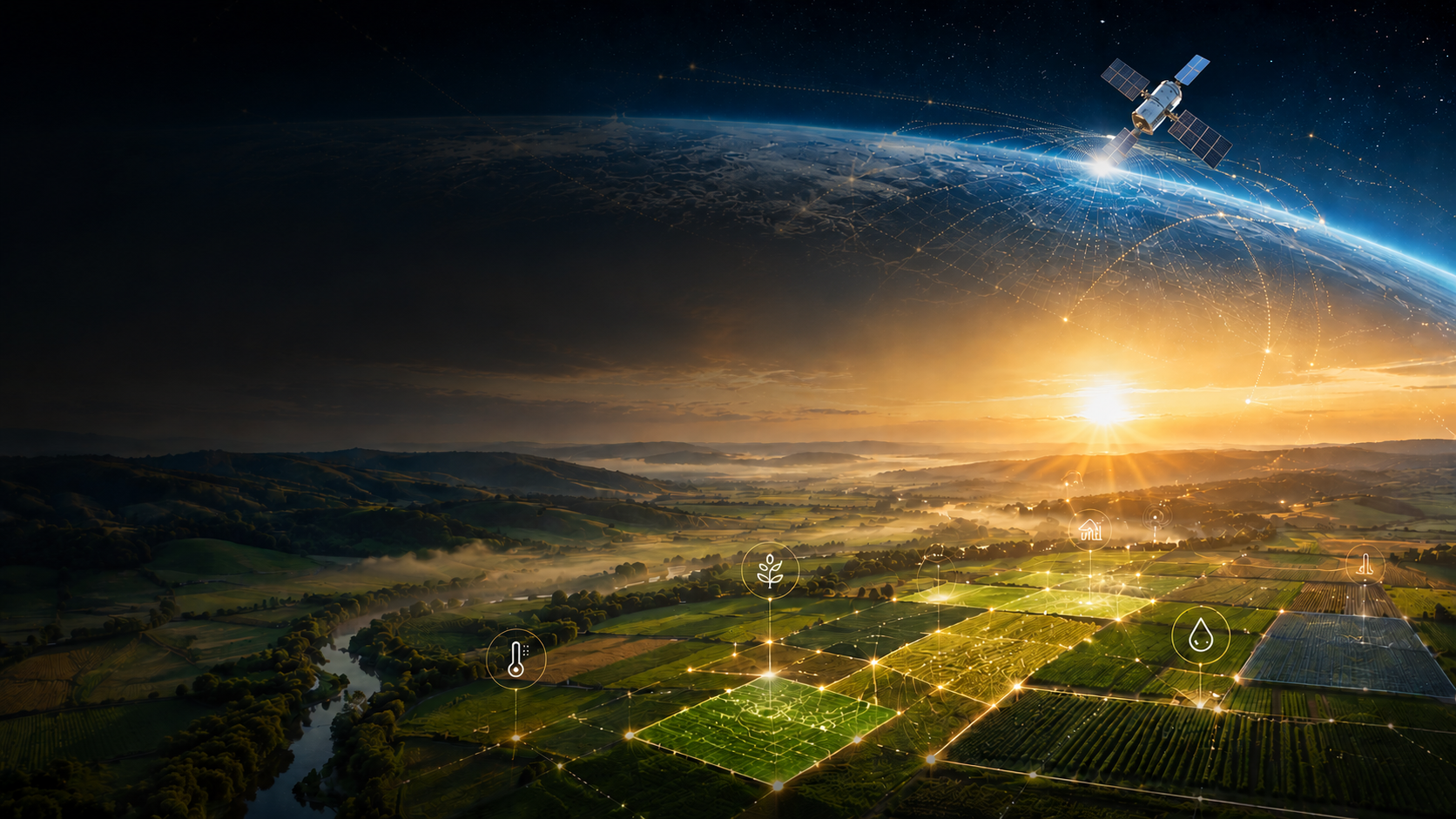
A robust environmental model also requires data fusion. Ground truth telemetry from weather stations, PAR sensors, soil moisture instrumentation and facility sensors can be combined with satellite layers, remote sensing, forecasts, soil grids and climate datasets to produce biome calibrated intelligence.
Satellite only agriculture is not sufficient. Remote layers provide coverage, but they require calibration against local sensor reality for high confidence decisions and meaningful predictive value.

Transport Visibility Within a Unified Model
Transport is often instrumented, but still isolated. A telematics stack may capture vehicle position, reefer setpoint behaviour, compartment temperature, shock events and route deviations, yet remain disconnected from the field, packhouse and cold room systems that define pre transport condition.
A transit excursion does not mean the same thing for two loads if one entered properly pre cooled and the other arrived with latent field heat and loading delays already embedded.
Within a unified model, GPS, reefer telemetry, shock monitoring, temperature monitoring, route replay, supplier scorecards and backlog recovery operate as extensions of the same lifecycle data fabric.
Fixed and mobile systems create an event stream where pre load, transit and post arrival conditions are analysed together. This strengthens exception management, supplier comparison, handover accountability and root cause analysis.
Vision AI: Closing the Operational Gap
Many environmental failures are operationally caused rather than sensor caused. Open door dwell, staging delays, misplaced pallets, loading errors, forklift movement and undocumented handling events can influence product condition without always triggering a sensor alarm.
Vision AI adds an operational layer to address this. In warehouse, dispatch and cold chain environments, visual systems can support loading verification, pallet tracking, forklift movement analysis, workflow confirmation and anomaly detection.
This helps capture the human and operational context that telemetry alone cannot always explain.

Deployment in Demanding Environments
The platform is most consequential where infrastructure is deployed in demanding environments. These include monitored cold rooms, ripening facilities, refrigerated logistics environments and compliance sensitive storage operations where uptime, alarm integrity, calibration traceability and response workflows matter.
In the South African export ecosystem, including PPECB related operations, reliable environmental control and auditable records are essential. Deployment can include wireless sensor networks, PLC connected monitoring points, calibrated probes, mapping and validation workflows, alarm escalation, compliance reporting and 24 hour support.
Export assurance is not only a document exercise. It is an infrastructure discipline.

Consumer Provenance: From Compliance Artefact to Trust System
At the consumer end, the same infrastructure can expose a controlled provenance view through a QR or barcode interface.
A consumer could access a curated subset of the lifecycle record, including origin, harvest context, production lineage, environmental conditions, logistics history, sustainability indicators and authenticity signals.
This changes traceability from a static compliance artefact into a trust system supported by the same chain of custody architecture used upstream.
Environmental chain of custody also carries anti counterfeit value. In premium exports, documentation alone can be reproduced or detached from physical reality. A persistent environmental record is harder to falsify because it is built from timestamped measurements, events, observations and infrastructure interactions, not paperwork.

The Earth Project: Spatial Environmental Intelligence
The Earth Project extends this logic from asset monitoring into spatial environmental modelling. It is a living intelligence layer for longitude and latitude analysis, commodity suitability modelling, historical environmental comparison, golden growing zone identification, biome matching and virtual environmental intelligence across regions.
The concept is to search for environments, not just locations. This enables producers, researchers and planners to understand where conditions are right before committing resources.

The Predictive Cold Chain
The future cold chain will be predictive, traceable and environmentally intelligent. It will be defined by integrated infrastructure: calibrated instrumentation, continuous telemetry, event aware workflows, AI assisted interpretation and traceability systems that preserve environmental state across the full product lifecycle.
The strategic shift is not simply monitoring an asset. It is maintaining the environmental identity of a product across research, production, storage, transport, retail and consumer trust. That identity, once established at source and carried forward without interruption, is what makes cold chain visibility meaningful.
"The future cold chain will be measured by continuity, not isolated checkpoints."
EUCA Technologies and Nvirosense are building the infrastructure layer that makes this possible.

Explore What's Possible
If your operation depends on environmental control, whether in the field, the packhouse, the cold room or in transit, we would welcome a conversation about how a connected infrastructure layer could strengthen your traceability, compliance and cold chain visibility.
Get in touch with the EUCA Technologies team to learn more about Nvirosense environmental monitoring, traceability and cold chain intelligence.